
Front Load Washing Machine Cleaning Singapore: The Right Way to Keep It Fresh
A front load washing machine should leave clothes smelling clean, not transfer a musty odour onto towels, bedding and freshly washed shirts.
When the washer itself begins to smell, the problem is often residue and moisture accumulating in areas a normal wash cycle does not fully clean.
The rubber door gasket can hold water, lint and hair. The detergent drawer can collect old detergent and fabric softener. The pump filter can trap debris, while drainage problems can leave dirty water inside the machine for longer than intended.
These issues can be particularly noticeable in Singapore homes where washing machines are commonly installed in HDB service yards, kitchens, bathrooms and compact utility spaces. Warm, humid conditions and limited airflow can slow drying between washes.
Front load washing machine cleaning therefore needs to cover more than the stainless-steel drum visible through the door.
Brilliant Miles currently provides door-to-door washing machine deep cleaning in Singapore. Its published front-load cleaning scope includes the rubber door gasket, detergent dispenser, pump filter, drum, drain hoses and filters, together with an assessment of machine balance.
The most effective approach is to combine regular household maintenance with professional cleaning or repair when the symptoms move beyond what can be safely handled at home.
Quick Answer: How Do You Clean a Front Load Washing Machine?

A practical front load washing machine cleaning routine has five parts:
1. Clean and dry the rubber door gasket.Remove trapped lint, hair and small objects from the folds and wipe away visible residue.
2. Remove and wash the detergent drawer.Clean the compartments, removable inserts and accessible dispenser cavity.
3. Run the manufacturer's drum-clean programme.Use Tub Clean, Drum Clean, Eco Drum Clean or the equivalent maintenance cycle for your model with the drum empty.
4. Clean the user-accessible pump filter.Follow the appliance instructions and prepare for retained water before opening it.
5. Help the washer dry after use.Remove wet laundry promptly and leave the door and detergent drawer slightly open where it is safe to do so.
If odour, black or grey flakes, standing water or drainage problems continue after these steps, the washer may need professional deep cleaning or repair diagnosis rather than stronger DIY chemicals.
What Parts of a Front Load Washing Machine Need Cleaning?
Front-load maintenance can be thought of as five separate zones:
Area | Why It Matters | Practical Maintenance |
Rubber door gasket | Can retain water, lint, hair and residue | Inspect and wipe regularly, especially lower folds |
Detergent dispenser | Detergent and softener can dry inside compartments | Remove and wash regularly |
Drum | Residue can accumulate within the washing system | Run the manufacturer-approved maintenance cycle |
Pump filter/drainage | Can collect lint, coins and small objects | Follow the model's maintenance instructions; inspect sooner if drainage slows |
Drying/ventilation | Trapped moisture contributes to musty conditions | Remove laundry promptly and ventilate the washer where safe |
The manufacturer's instructions should always take priority over a generic schedule because filter designs, approved cleaners and maintenance programmes differ between washing-machine models.
Why Does a Front Load Washing Machine Start Smelling?
A front loader commonly develops a musty smell when moisture and residue remain inside the appliance between cycles.
The door gasket is one common location.
Front-load washers need a watertight seal around the door. The folds of that seal can retain water along with lint, hair, tissue fragments, detergent, body oils and other debris.
The detergent dispenser creates another buildup area. Detergent and fabric softener can dry onto the drawer, inserts and internal channels.
Drainage can also affect odour.
If lint or debris partially blocks the user-accessible pump filter, the machine may empty less efficiently. A deeper pump, hose or drainage fault can cause similar symptoms.
Too much detergent can make the problem worse. Front-load machines use controlled amounts of water, so extra detergent does not automatically improve cleaning. Instead, some of it may remain as residue on internal surfaces.
The combination of water + detergent film + organic residue + limited drying creates conditions in which unpleasant odours can develop.
What Are the Signs That Your Front Load Washer Needs Cleaning?
A musty smell from the empty machine is one of the clearest signs.
Other possible indicators include:
laundry that smells stale immediately after washing
black, grey or slimy residue around the gasket
sticky detergent buildup
cloudy door glass
flakes or particles appearing on laundry
visible residue inside the drum
unpleasant odour around the lower filter area
Slow drainage requires additional attention.
If water remains in the drum, the machine repeatedly displays a drainage error or drainage becomes noticeably slower, the cause may extend beyond ordinary cleaning.
The filter could be blocked, but the pump, drain hose or another component may also need repair diagnosis.
How Should You Clean the Rubber Door Gasket?
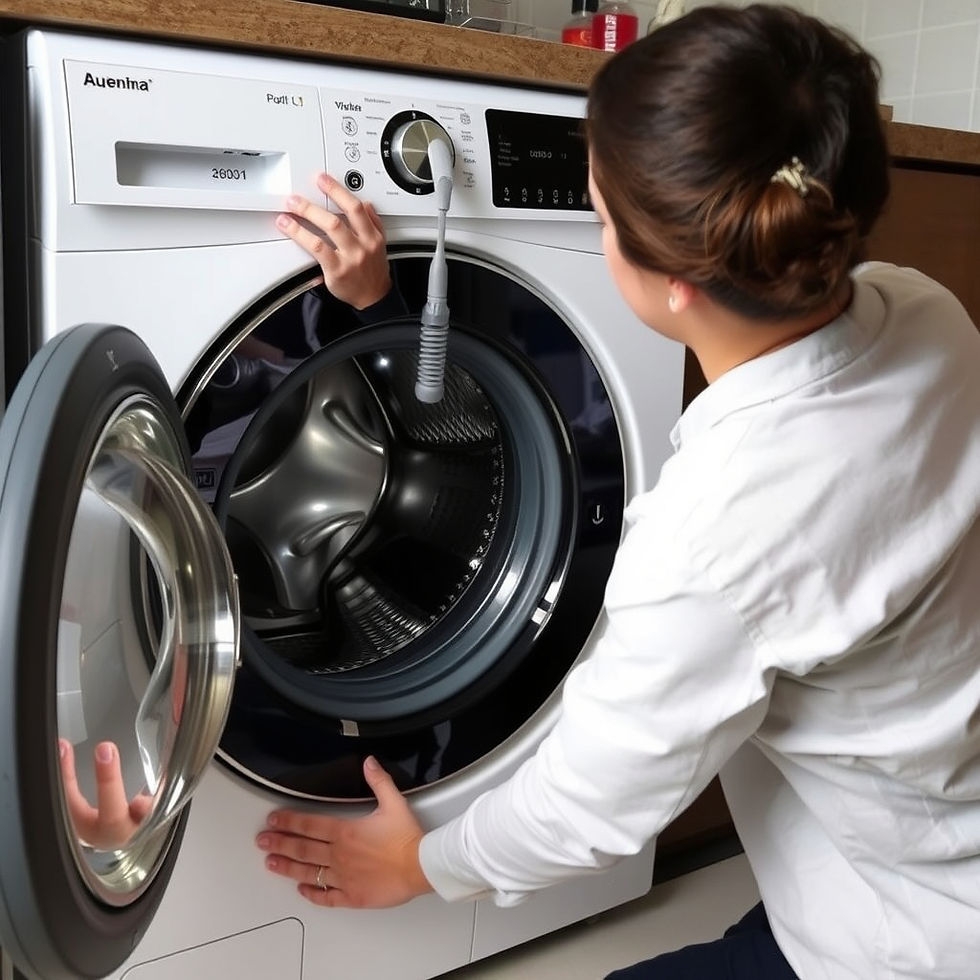
Open the washing-machine door and inspect the complete rubber seal.
Gently separate the folds without stretching or pulling the gasket excessively.
Pay particular attention to the bottom section because retained water and small objects often settle there.
Remove accessible debris such as:
lint
hair
tissue
coins
clips
buttons
Do not use knives, screwdrivers or other sharp objects around the gasket.
They can puncture the rubber or damage drainage holes.
For ordinary dirt, use a soft cloth or non-abrasive brush with a mild cleaning method permitted by the washer manufacturer.
After cleaning, wipe away remaining cleaner and dry the gasket thoroughly.
If mould-like residue is present, use only a cleaning product suitable for the machine and rubber seal, following the manufacturer's instructions for dilution, contact time, ventilation and rinsing.
Stronger chemicals are not automatically more effective.
What If Black Marks Stay on the Rubber Seal?
A black or grey mark does not always mean active residue remains.
Long-term contamination can permanently stain or discolour rubber.
After cleaning and drying the seal, inspect its condition.
If the gasket remains flexible, intact and free from strong odour, the remaining colour may simply be staining.
If it has become:
cracked
brittle
distorted
rough
persistently smelly
unable to seal properly
replacement or repair assessment may be more appropriate than repeated aggressive scrubbing.
How Do You Clean the Detergent Drawer?
Remove the detergent dispenser carefully, using the release mechanism if the washer has one.
Take out removable inserts or siphon caps only where the design allows it.
Wash the drawer and removable parts with warm water and an appropriate mild cleaner.
Use a soft brush for corners, channels and dried detergent.
The cavity behind the drawer may also contain residue.
Wipe accessible surfaces with a damp cloth rather than pouring water directly into the opening because electrical components may be located nearby.
Let the cleaned parts dry before reinstalling them.
Using the correct detergent dose afterwards can reduce how quickly residue returns.
How Should You Clean the Washing Machine Drum?
Most modern front loaders include a maintenance cycle such as:
Tub Clean
Drum Clean
Eco Drum Clean
or a similar programme.
Run the programme with the drum completely empty.
Do not put clothes or cleaning cloths inside.
Check the washing-machine manual before adding any cleaner.
Some models are designed to run their maintenance programme without additional detergent. Others allow a purpose-made washing-machine cleaner.
More cleaning product is not necessarily better.
Excessive cleaner can produce foam or leave additional residue.
After the cycle, inspect the drum, gasket, door glass and dispenser for particles loosened during cleaning.
Wipe away accessible residue and allow the machine to ventilate.
Can You Use Vinegar, Baking Soda or Bleach in a Front Load Washer?
These should not be treated as universal washing-machine cleaners.
Vinegar is acidic and may not be recommended for every rubber seal, hose or internal component.
Baking soda can remain in dispensers or drainage routes if excessive amounts are used or the powder does not dissolve properly.
Bleach may be permitted by some manufacturers, but the correct compartment, concentration and cycle vary by model.
The safest general rule is:
check the machine manual and use only products approved for your washer.
Never combine bleach with vinegar, ammonia, acidic products or other household chemicals because dangerous gases can be produced.
What Should You Avoid When Cleaning a Front Load Washing Machine?
Avoid turning routine maintenance into an appliance repair problem.
Do not:
mix bleach with vinegar, ammonia or acidic cleaners
assume vinegar or baking soda is approved for every washer
pour excessive detergent or cleaner into the machine
use knives or sharp tools inside the door gasket
force open a stuck pump filter
open service panels without following the machine instructions
pour large amounts of water into the dispenser cavity
dismantle electrical or internal mechanical components without appropriate knowledge
run repeated cycles when the washer is leaking, smoking or electrically tripping
If cleaning requires access beyond normal user-maintenance components, professional servicing is generally safer.
How Do You Clean the Drain Pump Filter?
First confirm that your washer has a user-accessible pump filter.
Not all designs are the same.
Switch the machine off and unplug it before accessing the filter where the manufacturer instructs you to do so.
Prepare towels and a shallow tray because retained water may escape.
Use the emergency drain hose first if the model provides one.
Remove accessible debris such as lint, hair, coins, buttons and clips.
Reinstall the filter securely before running the machine.
If the filter is clean but the washer still drains slowly or retains water, the issue may lie deeper in the pump, drain hose or another component.
At that point, cleaning should no longer be treated as the complete solution.
How Often Should You Clean a Front Load Washing Machine in Singapore?
There is no one cleaning schedule that applies to every front loader.
Frequency depends on:
washing-machine model
number of weekly loads
detergent amount
fabric-softener use
type of laundry
drainage performance
manufacturer instructions
A practical routine is:
Maintenance Task | When to Consider It |
Remove laundry | Immediately after the wash where possible |
Check/wipe gasket | Regularly, especially when water or debris is visible |
Clean detergent drawer | Inspect regularly and clean when residue develops |
Run drum-clean programme | When the machine requests it or according to the manual |
Clean pump filter | Follow model instructions; inspect sooner if drainage slows |
Professional deep cleaning | When odour/residue keeps returning despite proper maintenance |
The manual remains the best source for model-specific maintenance intervals.
How Can You Prevent Musty Odours From Returning?
The most effective prevention strategy is to reduce both moisture and residue.
Remove laundry promptly when the cycle ends.
Wipe retained water from the gasket, especially around the lower folds.
Leave the door and detergent drawer slightly open when the machine is not running if this is safe around children, pets and walkways.
Use the correct detergent type and dose.
Avoid unnecessary fabric softener.
Do not overload the washer.
Clothes need sufficient room for water and detergent to circulate.
Respond early if drainage becomes slower or residue starts appearing.
A small change is easier to investigate before every load begins smelling stale.
Why Does My Washer Still Smell After a Drum-Clean Cycle?
A drum-clean cycle does not clean every component equally.
Residue may still remain in:
gasket folds
detergent-dispenser housing
pump filter
drain hose
hidden surfaces around the washing system
The machine may also be retaining dirty water because it is not draining properly.
Another possibility is that the smell comes from the property's drainage connection rather than contamination inside the appliance.
When odour quickly returns after the gasket, dispenser, drum and filter have been cleaned correctly, deeper professional cleaning or repair diagnosis becomes more useful than repeatedly adding stronger chemicals.
What Do Black or Grey Flakes on Laundry Mean?
Black or grey particles are not automatically proof of mould.
Possible sources include:
detergent residue
fabric-softener buildup
lint
accumulated grime
residue loosened during a cleaning cycle
deteriorating internal material
Start with the accessible cleaning areas and the correct maintenance programme.
If particles continue appearing afterwards, contamination may be sitting on hidden surfaces or an internal component may be deteriorating.
That distinction may require professional assessment.
Is Front Load Washing Machine Cleaning Different From Top Load Cleaning?
Yes.
The two washer designs contain different areas that need attention.
A front loader uses a horizontal drum and watertight front door, so cleaning places particular emphasis on the rubber gasket, door area, detergent dispenser, drum and drainage/filter system.
A top loader opens from above and may use an agitator or pulsator. Its cleaning access points and internal layout therefore differ.
Brilliant Miles currently publishes separate deep-cleaning scopes for front-load and top-load washing machines rather than treating both designs identically.
DIY Cleaning vs Professional Cleaning vs Repair: Which Do You Need?
The right next step depends on the symptom.
DIY Maintenance Is Usually Appropriate When:
residue is limited to accessible gasket folds
the detergent drawer is dirty
the machine simply needs its scheduled drum-clean cycle
the accessible filter contains ordinary lint or debris
odour improves after proper cleaning and drying
Professional Deep Cleaning May Be More Appropriate When:
odour returns quickly after household cleaning
black or grey flakes continue appearing
contamination is visible beyond safely accessible areas
deeper dismantling may be required
the washer has not been properly deep cleaned for an extended period
Repair Diagnosis Is More Appropriate When:
water remains inside the drum
drainage problems continue after the filter is cleared
the washer leaks
recurring error codes appear
the machine makes grinding or abnormal noises
vibration becomes severe
the machine does not spin correctly
electrical tripping occurs
there is smoke or a burning smell
Cleaning removes contamination.
Repair addresses a mechanical, electrical or functional fault.
Brilliant Miles provides both deep cleaning and washing-machine repair services, allowing persistent odour or drainage symptoms to be assessed beyond cleaning when necessary.
When Should You Call for Professional Front Load Washing Machine Cleaning?

Professional cleaning becomes useful when ordinary household maintenance no longer resolves the problem.
Common triggers include:
persistent musty odour
recurring residue
flakes returning to laundry
contamination visible beyond user-accessible areas
a machine that requires partial dismantling for deeper cleaning
Brilliant Miles currently provides door-to-door deep cleaning so the washing machine can be serviced in its normal installation location.
Its published front-load scope includes removal of mould, mildew and soap scum from the rubber gasket, cleaning of the detergent dispenser and pump filter, drum cleaning, inspection and unclogging of drain hoses and filters, and assessment of machine balance.
Customers should confirm the exact dismantling included for their washer before booking because the amount of dismantling depends on the model and contamination level.
Does Professional Deep Cleaning Mean the Whole Drum Is Removed?
Not necessarily.
“Deep cleaning” does not have one universal dismantling scope.
Some washing machines can be cleaned effectively by removing or accessing selected components.
Others may require more dismantling when contamination is deeper.
Brilliant Miles' current front-load guide specifically advises customers to confirm which components will be dismantled and cleaned for their machine rather than assuming complete drum removal is included in every appointment.
This is particularly important for washer-dryer combinations and machines installed under counters or inside cabinetry.
How Long Does Professional Front Load Washing Machine Cleaning Take?
There is no one published duration that applies to every machine.
Brilliant Miles' current front-load guide states that professional cleaning time depends on the model, installation, contamination level and dismantling required. Customers should confirm the expected appointment duration after providing the appliance details.
A lightly contaminated accessible washer and a heavily soiled washer-dryer requiring greater dismantling should not be expected to take the same amount of time.
How Much Does Front Load Washing Machine Cleaning Cost in Singapore?
Professional cleaning prices depend on the machine type and service scope.
Brilliant Miles' current main cleaning page does not publish one universal base price for every washing-machine deep-cleaning appointment. Its current service information states that washing machines with a dryer carry an additional S$50 charge.
The company also currently advertises S$20 off for first-time customers booking washing-machine deep cleaning.
Customers should therefore request the full price for their exact machine and confirm:
front load or washer-dryer model
cleaning scope
dismantling included
any additional charges
whether repair work discovered during cleaning is separate
Do not assume that a generic online washing-machine cleaning price applies to every model.
When Does a Washing Machine Need Repair Instead of Cleaning?
Cleaning is appropriate when the main problem is contamination.
Repair is needed when the appliance itself is malfunctioning.
Possible repair symptoms include:
standing water
persistent slow drainage
repeated error codes
active leaking
grinding noises
severe vibration
failure to spin
door-lock faults
smoke
burning smell
repeated electrical tripping
A leaking front loader could have a damaged gasket, loose hose, pump fault, dispenser problem or internal connection issue.
A washer that fails to spin could be affected by incomplete drainage, belt wear, motor problems, door-lock faults or another drive-system issue.
Brilliant Miles currently provides separate washing-machine repair services and lists a S$50 troubleshooting price for repair diagnosis. Its repair service also advertises a 90-day workmanship guarantee.
If smoke, a burning smell or repeated electrical tripping occurs, stop using the machine and disconnect power when it can be done safely.
Do not run another test cycle simply to see whether the problem disappears.
Why Consider Brilliant Miles for Front Load Washing Machine Cleaning?
Brilliant Miles focuses on washing-machine deep cleaning, servicing and repair in Singapore.
Its current front-load deep-cleaning service specifically covers problem areas that an ordinary drum-clean cycle may not fully address:
rubber door gasket
detergent dispenser
pump filter
drum
drain hoses and filters
machine balance
The service is provided door to door, so customers do not need to transport a heavy washing machine to a workshop.
A further practical advantage is that Brilliant Miles also provides repair services.
That means the distinction between dirty washer and faulty washer does not have to be ignored.
A machine with ordinary detergent buildup may simply need cleaning.
A machine with odour plus standing water may need cleaning and drainage diagnosis.
A machine with leaks, recurring errors or electrical symptoms needs repair assessment rather than repeated chemical cleaning.
That distinction is often more useful than treating every washing-machine problem as dirt.
Frequently Asked Questions About Front Load Washing Machine Cleaning in Singapore
How Do You Properly Clean a Front Load Washing Machine?
Clean and dry the rubber gasket, remove and wash the detergent dispenser, run the manufacturer-approved drum-clean cycle with the machine empty, clean the user-accessible pump filter according to the manual and allow the washer to ventilate after use.
How Often Should You Clean the Rubber Door Gasket?
There is no universal fixed interval. Inspect it regularly, especially around the lower folds where water and debris collect. Wipe visible moisture and residue before it has time to build up.
Can You Use Vinegar or Bleach in a Front Load Washer?
Only if the washing-machine manufacturer permits the product and provides appropriate instructions. Never mix bleach with vinegar, ammonia or acidic cleaners.
Why Does My Washer Still Smell After Drum Cleaning?
The odour may remain in the gasket, dispenser, pump filter, drainage path or less-accessible internal surfaces. Poor drainage can also leave contaminated water inside the machine.
Why Are Black or Grey Flakes Appearing on My Clothes?
Possible sources include detergent residue, fabric softener, lint, accumulated grime or deteriorating internal material. Persistent flakes after proper household cleaning may justify professional assessment.
Can Permanent Black Marks on the Gasket Be Removed?
Not always. Cleaning may remove active surface contamination while leaving permanent rubber discolouration. A cracked, brittle, distorted or persistently smelly gasket may need replacement.
How Long Does Professional Front Load Washing Machine Cleaning Take?
The appointment duration depends on the washer model, installation, contamination level and amount of dismantling required. Brilliant Miles advises confirming the expected duration after providing the machine details.
How Much Does Professional Front Load Washing Machine Cleaning Cost?
Brilliant Miles does not currently publish one universal base deep-cleaning price on its main service page. It states that washer-dryer machines have an additional S$50 charge and currently advertises S$20 off a first deep-cleaning booking. Customers should request the full quote for their specific machine.
When Do You Need Professional Cleaning Instead of DIY Cleaning?
Consider professional cleaning when odour, flakes or deep contamination continue returning after the gasket, dispenser, filter and maintenance cycle have been handled correctly, or when safe cleaning would require further dismantling.
When Does a Washing Machine Need Repair Instead of Cleaning?
Arrange repair diagnosis when the washer leaks, retains water, repeatedly drains slowly, displays recurring error codes, makes abnormal noises, vibrates severely, fails to spin or develops electrical symptoms.
Final Thoughts: What Is the Right Way to Clean a Front Load Washing Machine?
The right way to clean a front load washing machine is not to pour a strong chemical into the drum and assume one cycle will reach every contaminated area.
A front loader has several separate areas that need attention.
Clean the gasket.
Wash the detergent dispenser.
Run the correct maintenance programme.
Maintain the accessible pump filter according to the machine instructions.
Allow moisture to escape after washing.
The manufacturer's instructions should determine which cleaners, maintenance programmes and filter procedures are appropriate for the specific model.
When household cleaning stops being enough, the next step depends on the symptom.
Persistent odour and hidden residue may justify professional deep cleaning.
Standing water, leaks, error codes, abnormal noises or electrical symptoms point more strongly towards repair diagnosis.
Brilliant Miles currently provides both door-to-door front load washing-machine deep cleaning and washing-machine repair in Singapore, allowing cleaning-related contamination and functional faults to be handled as separate problems rather than assuming one service solves everything.
For Singapore households, the most useful routine is therefore straightforward:
keep accessible areas clean → use the correct detergent amount → help the washer dry → respond early when smells or drainage change → move to professional cleaning or repair when DIY maintenance no longer matches the problem.
That approach gives every wash a cleaner environment while helping prevent a hygiene problem from being confused with an appliance fault.


Comments