
Washing Machine Repairs in Singapore: Costs, Faults and Service Guide
- brilliantmilesptel
- Jul 30
- 17 min read
Washing machine repairs in Singapore commonly cost around S$80 to S$200 according to Brilliant Miles’ published planning guide, although complicated motor, drum, bearing or electronic faults may cost more. Brilliant Miles currently lists an initial troubleshooting appointment at S$50, with any repair, replacement parts or additional labour quoted after diagnosis. These figures are planning references rather than guaranteed prices for every machine.
A washing machine breakdown can disrupt an entire household. When the appliance stops draining, leaks across the service yard, shakes violently or leaves clothes soaking wet, laundry quickly begins to pile up.
The problem can be especially stressful in Singapore homes where the machine may sit inside a compact HDB service yard, beneath a counter, beside built-in cabinets or near electrical outlets and floor traps. A small leak can damage flooring and fittings, while repeated operation of a faulty machine may worsen an electrical or mechanical problem.
Professional washing machine repair should begin with diagnosis rather than guesswork. The technician should identify the affected system, explain the likely cause, provide a clear quotation and test the appliance after the approved work is completed.
Brilliant Miles provides door-to-door washing machine troubleshooting and repair services across Singapore. Its published repair scope includes door locks, tubs and drums, pumps and drainage systems, motors, belts, pulleys and dispenser components.
This guide explains common washing machine faults, expected repair costs, safe checks homeowners can perform, how repair differs from deep cleaning and when replacing the appliance may make more financial sense.
Key Takeaways

A washing machine that will not turn on, drain, spin or complete a cycle may have a mechanical, electrical, drainage, locking or control-system fault. Similar symptoms can have different causes, so parts should not be replaced solely because of an error code or visible symptom.
Brilliant Miles currently publishes a S$50 troubleshooting fee. Its separate repair-cost guide states that washing machine repairs in Singapore commonly fall around S$80 to S$200, depending on the fault, appliance brand, labour and parts.
Homeowners can safely check the socket, circuit breaker, door closure, visible hoses, water tap, load balance and an accessible pump filter. Internal electrical testing, motor repair, bearing work, drum dismantling and control-board diagnosis should be handled by a suitable technician.
Repair may be worthwhile when the fault is isolated, suitable parts remain available and the rest of the machine is in reasonable condition. Replacement deserves stronger consideration when several major components are failing, the cabinet is badly corroded or the repair cost approaches a substantial portion of the complete replacement cost.
Active leaks, smoke, burning smells, electrical tripping and strong metal-on-metal noises require prompt attention. The appliance should not be repeatedly restarted in an attempt to force it through another cycle.
How This Guide Was Developed
This guide combines the original Brilliant Miles repair article with information published on Brilliant Miles’ current repair, deep-cleaning and repair-cost pages.
The S$50 troubleshooting fee and listed repair categories come from the company’s live repair page. The S$80 to S$200 figure comes from Brilliant Miles’ published washing-machine repair-cost guide and should be treated as a broad planning range rather than a fixed quotation.
Brilliant Miles has a commercial interest in providing the services discussed. Customers should compare the diagnosis, complete quotation, parts availability, workmanship terms and suitability before approving any repair.
What Does Washing Machine Repair Include?
Washing machine repair involves identifying and correcting a fault that prevents the appliance from operating normally.
The problem may involve the water inlet, drainage path, pump, door or lid lock, motor, belt, pulley, drum, suspension, bearings, internal hoses, wiring, sensors or electronic controls.
A repair appointment may include fault assessment, a test cycle, panel removal, blockage inspection, component testing, adjustment, part replacement and final verification.
Brilliant Miles states that its door-to-door service removes the need for customers to transport a heavy appliance to a repair centre. The technician can assess the machine together with its normal power connection, water inlet, drainage route and installation space.
How Is Repair Different From Maintenance and Deep Cleaning?
Repair addresses a functional failure. The washing machine may not start, fill, tumble, agitate, drain, spin, lock or complete its programme.
Maintenance focuses on keeping the appliance operating normally and noticing developing problems. This may include observing hoses, filters, balance, drainage and general machine performance.
Deep cleaning targets grime, detergent residue, lint, mould, soap scum and odours inside the drum, dispenser, gasket, filter and other accessible areas.
Brilliant Miles publishes separate deep-cleaning scopes for front-load and top-load machines. Its cleaning service includes work around the drum, dispenser, gasket, drain hoses, filters and machine balance, depending on the appliance design.
Some machines may need both repair and cleaning. A blocked drainage route may contain lint or debris, while an unpleasant smell may remain even after the mechanical drainage fault has been corrected.
This repair guide focuses primarily on faults that prevent the machine from functioning. Deep cleaning should not be used as a substitute for diagnosing an electrical, mechanical or control-system problem.
Brilliant Miles’ Observe–Test–Explain–Repair–Verify Process
A responsible repair service should follow a clear process rather than replacing the component most commonly associated with the symptom.
The Observe stage records what the customer experienced. This includes the error code, sound, smell, leak location, cycle stage and whether the problem happens every time.
The Test stage checks the likely system. The technician may observe filling, drum movement, drainage, spinning and locking before opening accessible sections.
The Explain stage gives the customer a diagnosis or reasonable repair recommendation. The technician should identify what is faulty, what work is proposed and whether another issue may be contributing.
The Repair stage begins after the customer approves the quotation. The work may involve clearing a blockage, adjusting a component or replacing a faulty part.
The Verify stage confirms that the original symptom has been resolved. The appliance should complete the relevant functional checks without new leakage, error messages or abnormal sounds.
What Are the Most Common Washing Machine Faults in Singapore?
Many washing machine symptoms fall into several connected systems: power, water supply, drainage, drum movement, locking, suspension and electronic control.
Why Will the Washing Machine Not Turn On?
A washing machine that does not power on may have an external supply problem or an internal fault.
Start by checking whether the wall switch is on, the plug is firmly connected and the household circuit has not tripped. Another low-power appliance can be used to confirm the socket only when the area is dry and there is no sign of electrical damage.
The washer door or lid must also close correctly. Many machines will not start unless the locking system confirms that it is secure.
When the socket works and the machine remains unresponsive, possible causes include the cable, internal fuse, door lock, control panel, power module, wiring or another electronic component.
Do not open electrical sections while the appliance is connected. A machine that repeatedly trips the circuit should remain switched off until inspected.
Why Does the Washer Fill but Not Wash?
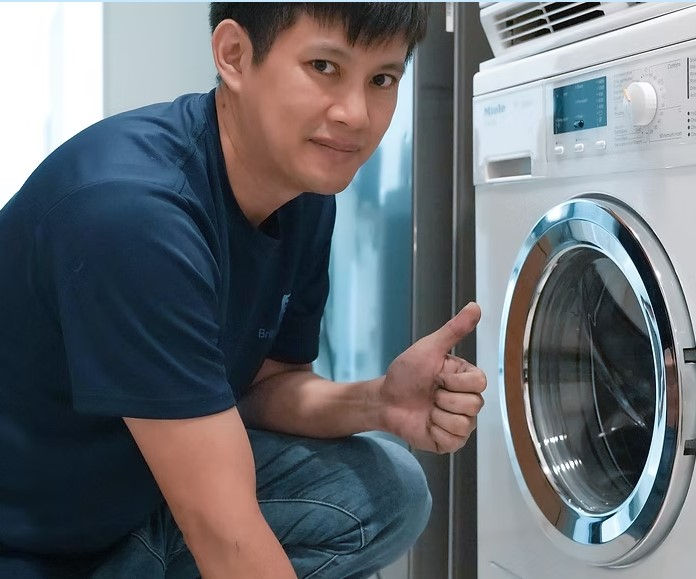
When water enters the drum but washing does not begin, the problem may involve the motor, belt, pulley, drum movement, door lock, water-level sensor or electronic controls.
A heavy or uneven load can sometimes stop normal movement. Remove some items, redistribute the laundry and restart the appropriate programme once.
When the appliance continues to hum, click or remain still with a normal load, stop trying to force the cycle. Repeated attempts can place additional demand on the motor or drive system.
Brilliant Miles lists motor checks, belt and pulley adjustment, tub and drum repairs and door-lock work among the services that may follow troubleshooting.
Why Is Water Remaining Inside the Drum?
Standing water usually means that the machine cannot drain correctly.
Possible causes include a blocked pump filter, kinked drain hose, clogged outlet, trapped object, failing pump or control fault.
Coins, tissues, clips, buttons, lint and small clothing items may enter the drainage system during everyday washing.
An accessible filter can sometimes be checked using the machine instructions. Switch off the appliance first and prepare towels and a shallow container because trapped water may escape when the filter is opened.
When the visible filter is clear but the machine still will not drain, the problem may sit deeper inside the pump, hose or drainage path. Brilliant Miles includes pump and drain repairs in its listed washing-machine services.
Why Does the Washing Machine Not Spin?
A washing machine that washes but does not spin may leave laundry dripping wet.
The cause may be an unbalanced load, incomplete drainage, worn belt, motor problem, damaged suspension, faulty door lock or electronic-control issue.
First check whether the machine has drained. Many washers will not enter a high-speed spin while water remains inside the drum.
Remove some laundry, distribute the remaining items evenly and attempt a separate spin programme once.
A machine that repeatedly refuses to spin with a balanced load should be diagnosed professionally. Replacing the motor without checking drainage, the locking system and drive components could fail to solve the real fault.
Why Does the Machine Shake or Make Loud Noises?
Some vibration is normal during high-speed spinning, but violent movement, scraping, grinding, deep rumbling or repeated banging is not.
The washer may be uneven or sitting on an unstable surface. Heavy items can also gather on one side and create temporary imbalance.
Persistent noise may indicate worn shock absorbers, weakened suspension, a loose pulley, bearing damage, a trapped object or a problem with the drum support.
Strong metal-on-metal noises deserve prompt inspection. Continued operation may damage the drum, seal, cabinet, hoses or nearby fittings.
Why Is Water Leaking Around the Washer?
Washing machine leaks may originate from the inlet hose, drain hose, door gasket, dispenser, pump, internal pipework or household drainage connection.
Switch off the appliance and close the water tap when the leak is active or substantial. Dry the surrounding floor and avoid using the machine until the source has been identified.
Leaks can be especially disruptive in HDB flats and condominiums because water may spread through a compact service yard, enter built-in cabinetry or affect the unit below.
The technician should inspect both the appliance and the property connection.
A drainage overflow or loose external hose may create a leak even when the machine itself is not internally damaged.
Brilliant Miles identifies faulty seals, hose problems and pump issues as common washing-machine leak sources.
What Does a Burning Smell Mean?
A burning smell may indicate an overheating motor, slipping belt, jammed component, damaged wiring or another electrical fault.
Stop the appliance immediately and disconnect it when it is safe to do so.
Do not run another cycle to see whether the smell disappears. Mention the smell when booking so the technician can prepare for an electrical or mechanical assessment.
Smoke, visible sparking or scorch marks require the appliance to remain disconnected.
Why Do Clothes Smell Musty After Washing?
Musty laundry can result from detergent buildup, mould, lint, trapped moisture, stagnant water or poor drainage.
Front-load machines commonly collect residue around the door gasket and dispenser when moisture remains trapped. Top-load machines can also accumulate buildup around the drum and components beneath accessible surfaces.
A drum-cleaning programme may improve mild residue, but recurring odour can indicate contamination beyond the visible surface.
Brilliant Miles provides separate top-load and front-load deep-cleaning services. Its published scope includes residue removal, dispenser cleaning, drain-hose and filter inspection, drum cleaning and balance assessment.
Odour alone does not always require repair. However, a musty smell combined with standing water or slow drainage should be diagnosed before cleaning is treated as the complete solution.
What Do Repeated Error Messages Mean?
An error code means the washing machine has detected an abnormal condition.
Depending on the brand and model, the code may relate to water filling, drainage, door locking, motor movement, heating, load balance or communication between electronic components.
Record the complete code and take a clear photograph before restarting the appliance.
A reset may clear a temporary interruption. A code that returns should be investigated rather than repeatedly dismissed.
Provide both the error photograph and the model number when booking. Error meanings can differ between manufacturers and even between models from the same brand.
Are Front-Load and Top-Load Repairs Different?
Front-load and top-load washing machines carry out similar washing functions but use different layouts and mechanisms.
A front-load machine has a horizontal drum, door gasket, locking system, drum support and suspension components. Frequent repair concerns can include gasket leaks, lock failure, drainage trouble, bearing noise and drum-support problems.
A top-load machine opens from above and may use an agitator or pulsator. Possible faults include lid-switch failure, weak agitation, drive trouble, drainage problems and spin imbalance.
Washer-dryer combinations contain washing and drying components within the same cabinet. Heating, airflow, moisture sensing and additional electronics can make diagnosis more involved.
Brilliant Miles describes its repair service as inclusive of different brands and models. Customers should still provide the exact model before booking so compatibility and parts availability can be checked.
What Happens During a Professional Repair Appointment?
A professional repair appointment normally begins with questions about what happened and when the problem started.
The technician may ask which programme was running, whether an error appeared and whether the machine recently became slower, louder or less stable.
The external inspection checks the cable, hoses, connections, door, gasket, dispenser, cabinet and surrounding floor for damage, water, rust or overheating.
The appliance may then be run through a short programme or diagnostic mode to observe filling, drum movement, drainage, spinning and locking.
When required, accessible panels may be opened to inspect the pump, motor, belt, pulley, wiring, valves, hoses or control system.
Once the fault is identified, the technician should explain the recommended work and cost before replacing parts.
After the approved repair, the appliance should be tested again. The customer should understand whether the issue has been fully resolved and whether any limitation remains.
How Much Do Washing Machine Repairs Cost in Singapore?

Brilliant Miles currently lists troubleshooting at S$50. Its published repair-cost guide states that customers may expect to pay approximately S$80 to S$200 for washing-machine repair in Singapore, depending on the repair, brand, model, labour and parts.
The S$80 to S$200 range should be treated cautiously. It is a broad estimate from Brilliant Miles’ own content and does not mean every repair will fall within that band.
A blocked drain hose, loose fitting or adjustment may be less involved than a pump, motor, bearing, drum or electronic-control repair.
Repairs requiring partial dismantling, specialised parts or another visit can cost more.
Before approving work, ask whether the S$50 troubleshooting fee is separate from the repair quotation, whether it is credited when work proceeds and whether transport or return visits are charged separately.
The quotation should identify labour, replacement parts and any known exclusions.
Why Do Repair Prices Vary?
Machine design affects access. A pump that can be reached through a lower panel may require less labour than a part located behind the drum or beneath stacked appliances.
Brand and model affect component availability. Some parts are commonly stocked, while others must be ordered or are no longer available.
The exact fault also matters. A symptom that appears minor can involve several systems, while a dramatic drainage error may sometimes be caused by a simple obstruction.
Installation conditions influence labour. Machines fitted tightly beneath counters, inside cabinetry or below dryers may require additional work before the technician can access the affected area.
A second visit may be necessary when the required part cannot be confirmed or sourced during the first appointment.
What Should Be Included in the Repair Quotation?
The quotation should identify the diagnosed or suspected fault and the proposed remedy.
It should separate the troubleshooting fee, labour and replacement parts where possible.
The customer should know whether the quotation includes installation, testing and another visit if a part must be sourced.
The technician should explain whether the replacement part is new, manufacturer-supplied, compatible or reconditioned.
Workmanship coverage should be stated clearly. Brilliant Miles’ public repair page currently promotes workmanship support for eligible repairs but contains inconsistent references to the coverage period. Customers should therefore confirm the current duration, covered fault and exclusions in writing before approving work.
The quotation should also explain what happens when dismantling reveals an additional fault. Further chargeable work should not proceed without approval.
What Does “No Fix, No Payment” Mean?
Brilliant Miles prominently advertises a no-fix, no-payment approach while also listing a S$50 troubleshooting fee.
These statements can be interpreted in several ways unless the booking terms explain how they work together.
Customers should ask whether the troubleshooting fee remains payable when the machine cannot be repaired, when a required part is unavailable or when the customer declines the quoted repair.
They should also confirm whether ordered parts, transport or other costs can be charged even when the appliance is not restored.
A clear written answer is better than relying only on a headline promise.
Should You Repair or Replace the Washing Machine?
Repair generally makes sense when the appliance has otherwise been reliable, the fault is isolated and the required part remains available at a reasonable cost.
Replacement deserves stronger consideration when the washer has multiple major faults, extensive corrosion, structural drum damage, repeated electrical trouble or a long history of costly repairs.
The repair quotation should be compared with the complete cost of a comparable replacement, including delivery, removal, installation, new hoses and any changes needed for the existing space.
A practical guideline is to reconsider a major repair when it approaches about half the full replacement cost. This is a decision aid rather than a universal rule.
A small pump repair in an otherwise sound machine may provide good value. A major repair may be less attractive when the washer also has bearing noise, rust and control problems.
Ask the technician whether the diagnosed fault appears isolated and whether other major components show visible wear.
Does the Age of the Machine Decide Whether Repair Is Worthwhile?
Age is important but should not be the only factor.
An older washer that has been reliable may still be worth repairing when one accessible component fails.
A newer appliance may be a poor repair candidate when it has severe corrosion, water damage or several failing systems.
Parts availability, repair history, original machine quality and current condition often matter more than age alone.
What Can You Check Safely Before Calling a Technician?
Confirm that the washing machine is connected to a working socket and that the household circuit has not tripped.
Check that the door or lid closes completely and that the selected programme has been started correctly.
For a drainage problem, inspect the visible hose for kinks and clean the accessible pump filter according to the manufacturer’s instructions.
For vibration, check that the machine stands firmly and that the load is distributed evenly.
For slow filling, confirm that the water tap is open and that the visible inlet hose is not crushed.
Stop when internal access, live electrical testing or dismantling is required.
Burning smells, smoke, scorch marks, electrical tripping, major leaks and strong grinding noises require professional attention.
How Should You Prepare for a Doorstep Repair Appointment?
Remove laundry from the drum where possible and clear detergent containers, baskets and household items from around the machine.
Do not dismantle the washer before the visit. Mention standing water when booking so the technician can prepare for controlled drainage.
Take a photograph of the model label and any error display.
Customers in condominiums should confirm visitor registration, parking, loading access and contractor entry requirements.
Mention whether the machine is beneath a counter, inside cabinetry or below a stacked dryer. Restricted access may affect the repair method.
Tenants should check whether the landlord or property manager must approve repairs or replacement parts.
Ensure that the technician can reach the electrical socket, water tap and drainage connection safely.
How Can You Reduce Future Washing Machine Faults?
Avoid overloading the drum. Excessive weight places additional demand on the motor, suspension, bearings and drive components.
Use an appropriate amount of detergent. Too much detergent can create heavy foam and leave residue inside the dispenser, gasket, drum and drainage path.
Check pockets before loading clothes. Coins, tissues, clips and other small objects may block the filter or damage internal parts.
Leave the door or lid and dispenser slightly open after use when it is safe to do so. Better airflow helps moisture escape in Singapore’s humid conditions.
Wipe the gasket and dispenser and clean accessible filters according to the appliance instructions.
Inspect hoses for cracking, bulging, rust around connectors and slow drips.
Respond to new noises, vibration, odours and delays early rather than waiting for the washer to stop completely.
How Do You Choose a Washing Machine Repair Service in Singapore?
Choose a provider that explains its troubleshooting charge, obtains approval before replacing parts and provides clear workmanship terms.
Confirm that the technician handles the relevant machine type and model.
Ask what the visit includes and whether a second appointment will incur additional charges.
Door-to-door service can be convenient because the technician assesses the machine together with its existing power, water and drainage connections.
Brilliant Miles provides doorstep repair appointments and lists support for door locks, drums, pumps, drains, motors, belts, pulleys and dispenser systems.
The provider should also explain whether parts and labour receive the same coverage and whether the coverage applies only to the original fault.
What Evidence Should a Repair Provider Show?
A repair company should be able to explain its diagnosis in understandable terms.
Useful evidence may include the fault code, visible damage, test result, worn part or comparison between abnormal and normal operation.
The customer should not be pressured to approve an expensive component solely because of the symptom.
A service report or invoice should identify the work completed and the part replaced.
A genuine case study with the customer’s permission can also demonstrate how the company approaches diagnosis, quotation, repair and final testing.
Illustrative Repair Scenario
The following scenario is illustrative and is not presented as a Brilliant Miles customer case.
A front-load washing machine stops before spinning and leaves water in the drum. The display shows a drainage error.
The symptom might suggest a failed pump, but the repair process should begin by checking the filter, drain hose, pump area and water flow.
A trapped coin or fabric item may be blocking the pump. In that situation, removing the obstruction and testing the machine may restore drainage without pump replacement.
When the pump itself is damaged, the technician can then explain the replacement required and test drainage and spinning after installation.
The example shows why diagnosis should come before replacement.
Why Consider Brilliant Miles for Washing Machine Repair?
Brilliant Miles provides door-to-door troubleshooting and repair for washing machines in Singapore.
Its repair page lists work involving door locks, tubs, drums, pumps, drainage systems, motors, belts, pulleys and dispenser components.
The doorstep arrangement allows the technician to assess the washer in its normal installation environment without requiring the customer to transport the appliance.
Brilliant Miles currently lists troubleshooting at S$50 and promotes a no-fix, no-payment approach together with workmanship support for eligible repairs. The exact interaction between the fee, repair commitment and coverage terms should be confirmed during booking.
When the machine functions but suffers from grime, detergent buildup or odour, Brilliant Miles also offers separate deep-cleaning services for front-load and top-load machines.
Frequently Asked Questions
How much does washing machine repair cost in Singapore?
Brilliant Miles publishes a S$50 troubleshooting fee. Its separate cost guide gives a broad estimated repair range of approximately S$80 to S$200, depending on the appliance, fault, labour and parts. Complex repairs may cost more.
Is the S$50 troubleshooting fee included in the final repair cost?
Brilliant Miles’ public repair page does not clearly state whether the fee is always credited when repair proceeds. Customers should confirm this before booking.
How long does a washing machine repair take?
Diagnosis and a minor repair may be completed during one appointment. Work involving unavailable parts, major dismantling or complex electronic faults may require more time or another visit.
Can a washing machine be repaired at home?
Many drainage, locking, belt, pump and component repairs can be completed at the property. Some complex work may require additional equipment, parts or workshop assessment.
Can I continue using a leaking washing machine?
No. Switch off the appliance and close the water supply when there is an active leak. Continued operation may worsen the fault or allow water to reach electrical components and surrounding finishes.
Can a washing machine with water inside still be repaired?
Yes. Tell the repair provider that the drum contains water so the technician can prepare to drain it safely before examining the filter, pump or hose.
Is it worth repairing an older washing machine?
It can be worthwhile when the machine has otherwise been reliable and the fault involves one reasonably priced component. Replacement may be more practical when several major systems are failing or suitable parts are unavailable.
Should I repair a washing machine that makes bearing noise?
Bearing repair can involve significant dismantling, depending on the machine design. The quotation should be compared with the washer’s overall condition and complete replacement cost.
Does an error code identify the exact faulty part?
Not always. An error code normally identifies an abnormal system or condition. Testing is still needed because several causes may trigger the same code.
What washing-machine information should I provide when booking?
Provide the machine type, brand, model number, approximate age, error code and a description of the fault.
Mention standing water, major leakage, burning smells, tripping or unusual noises.
Are repair and deep cleaning the same service?
No. Repair corrects a functional fault. Deep cleaning removes residue, mould, lint and odours. A machine may require one service or both.
What should a repair invoice include?
The invoice should identify the diagnosis, labour, replacement part, work completed, total amount and applicable workmanship terms.
Conclusion
Washing machine repairs are easier to manage when warning signs are addressed early.
Standing water, repeated error messages, failed spinning, unusual noise, leakage, burning smells and electrical tripping should not be treated as normal inconveniences.
Safe external checks may resolve a simple power, load or hose problem. Internal electrical, motor, drum and control-system work should be handled by a suitable technician.
Brilliant Miles provides door-to-door washing machine troubleshooting, repair and maintenance across Singapore. Its Observe–Test–Explain–Repair–Verify process gives customers a practical way to understand what should happen before chargeable work is approved.
Brilliant Miles currently publishes a S$50 troubleshooting fee and a broad repair-cost estimate of approximately S$80 to S$200. The final amount depends on the diagnosis, appliance design, labour and parts.
Regular filter care, suitable detergent use, balanced loads, hose checks and early diagnosis can reduce avoidable breakdowns and help the washing machine remain dependable for longer.


Comments